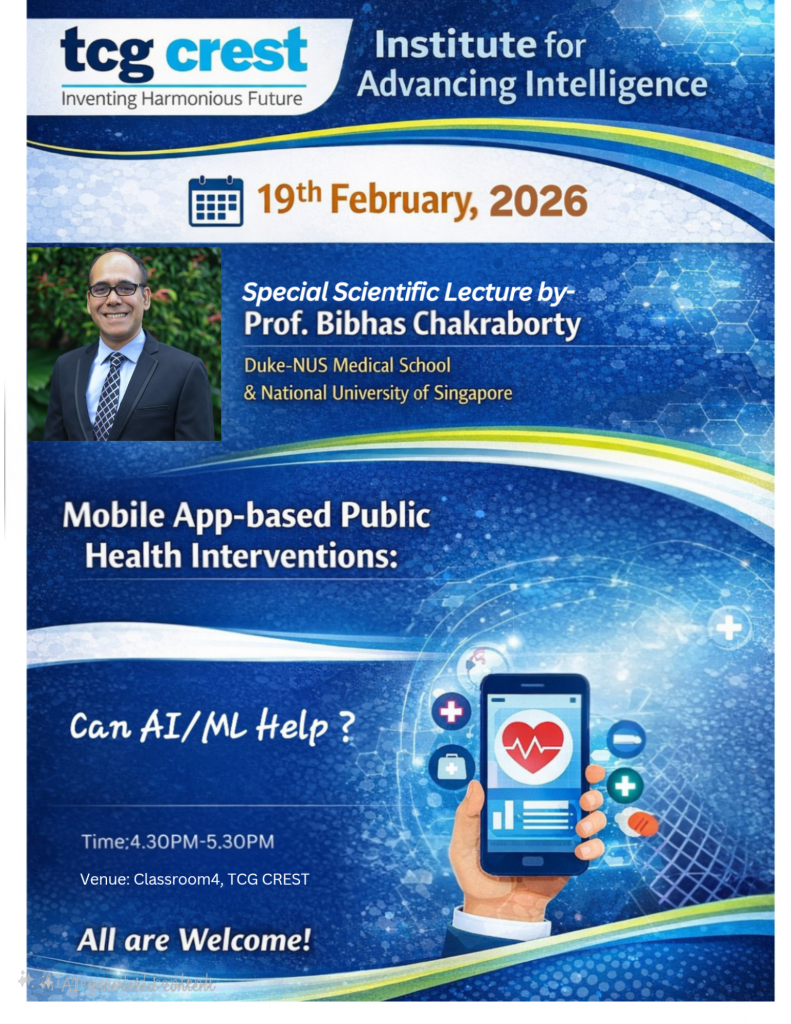
Institute for Advancing Intelligence (IAI), TCG CREST warmly invites you to attend the upcoming scientific lecture by Prof. Bibhas Chakraborty, Associate Professor and Deputy Director, Centre for Biomedical Data Science, Duke-NUS Medical School, Singapore.
Title:
Mobile App-based Public Health Interventions: Can AI/ML help?
Abstract:
Mobile health (mHealth) interventions (e.g., motivational text-messages or nudges to promote healthy behaviors or mental wellness) are becoming increasingly common in public health, in tandem with advances in mobile and wearable sensor technologies. In this talk, we will discuss an innovative mHealth intervention framework called just-in-time adaptive interventions (JITAIs) and a corresponding innovative experimental design called the micro-randomized trial (MRT) that involves sequential, within-person randomization over many instances. The basic MRT design can be further improved to make it adaptive, thereby enabling it to learn from accumulated data as the trial progresses. This is appealing from an ethical perspective since the adaptive learning tends to make better interventions available to the participants sooner. Adaptive learning in such settings is often operationalized via Reinforcement Learning (RL) – a sub-area of AI/ML. Specifically, we will discuss the role of RL algorithms in mHealth using real-world case studies from USA, UK, and Singapore.
About the Speaker:
Bibhas Chakraborty is a tenured Associate Professor and Deputy Director of the Center for Biomedical Data Science at the Duke-National University of Singapore (Duke-NUS) Medical School, with joint appointments at NUS and the Duke University. Previously (2009-13), he was an Assistant Professor of Biostatistics at Columbia University. He holds a Ph.D. in Statistics from the University of Michigan. He is a recipient of the Calderone Research Award for Junior Faculty from the Mailman School of Public Health, Columbia University (2011), Young Statistical Scientist Award from the International Indian Statistical Association (2017) and an Elected Member of the International Statistical Institute (2022). His core areas of research include dynamic treatment regimens, adaptive clinical trial designs, causal inference, reinforcement learning, interpretable machine learning, analysis of electronic health records, and mobile health. He authored the first textbook on dynamic treatment regimens.
We look forward to your presence.